

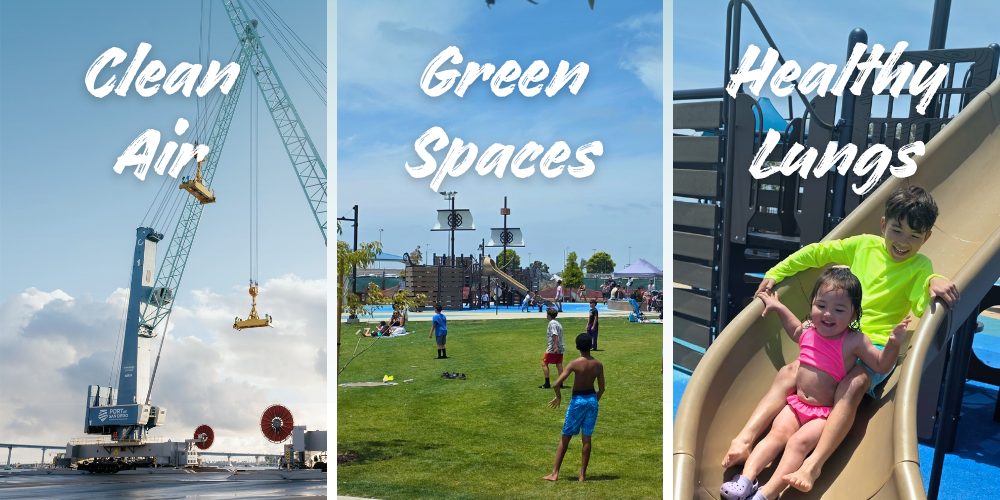
Welcome to the fall edition of the Healthy Portside Community Newsletter! This newsletter is part of EHC’s partnership with the Port of San Diego to inform and engage Portside residents on the Port’s Clean Cargo Project (CCP). In this newsletter, you’ll read about Bali Express Services, a leader in zero-emission vehicles (ZEV) and sustainable transportation logistics, meet a Barrio Logan daycare manager advocating for a healthier Portside, and get updates on the CCP.
What’s in the Fall Edition?
- Meet Concepcion Ramirez, a daycare owner and clean air advocate
- Clean Cargo Project updates
- Interview: Juan Baez, Company Director of the first transportation company to make a border crossing between the US and Mexico with an electric truck.
- Upcoming events
Meet Concepcion Ramirez, a daycare owner and clean air advocate
“I want to continue educating and organizing my neighbors so together we can reduce air pollution in Barrio Logan and neighboring Portside communities.”
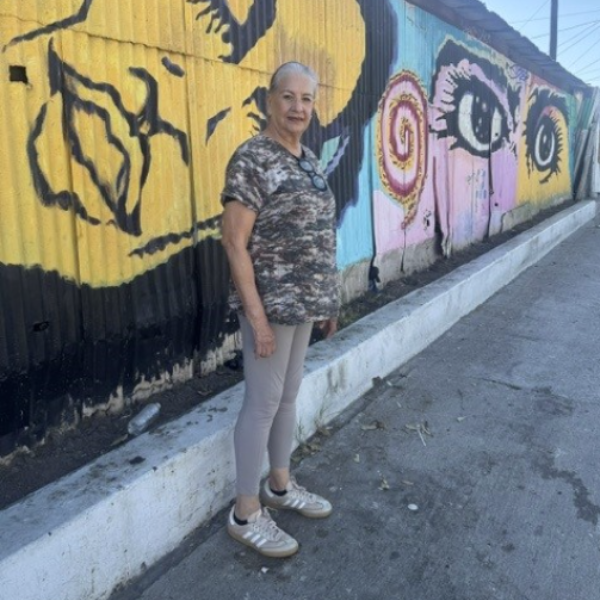
Concepcion has lived in Barrio Logan for 24 years. She runs an in-home daycare with her daughter. They care for children ages newborn to four years old. Concepcion started volunteering with EHC in 2019, when her neighborhood was plagued by nauseating odors from New Leaf Biofuel, a local business. The smell was so bad that she couldn’t open her windows. She organized with her neighbors to hold the company accountable and gave interviews to the media to bring attention to what they were going through.
She joined the Portside CAT in November of 2025. As a member of the CAT, her goal is to work with the Port to reduce the impact of air pollution on her community from trucks and businesses in and around Barrio Logan and National City.
If you are interested in learning more about the Portside CAT and how you can join, contact Monserrat Hernández at MonserratH@environmentalhealth.org.
Clean Cargo Project Updates
Out with the fuel, in with the electric
The CCP is a transformative project to reduce harmful air pollution in Portside communities by electrifying Port operations and supporting zero-emission (pollution-free) heavy-duty trucks and cargo-handling equipment.
Tenth Avenue Marine Terminal (TAMT)
- SSA Marine is preparing to order 11 all-electric forklifts. They anticipate that the equipment will be delivered in about 15 months. SSA Marine will be issuing purchase orders for the remaining pieces of all-electric ZE cargo handling equipment to replace fuel-burning equipment that will be permanently scrapped. The remaining pieces are 1 reach stacker and 5 utility tractor rigs (UTRs)
- Dole Fresh Fruit Company has successfully deployed the 3 electric utility tractor rigs (UTR) it received in June. The UTRs are currently operating at the TAMT. The remaining seven are expected to arrive later this calendar year.
- Construction continues on Phase 4 of the Tenth Avenue Marine Terminal (TAMT) 12-kV modernization, which includes:
- upgrading the electrical system that loops around the terminal to support the chargers needed for the ZE equipment and shore power,
- 12 charging units and supporting infrastructure, and
- 1 shore power outlet for commercial harbor craft.
Tidelands Avenue Electric Truck Hub
- On August 11th, the Board of Port Commissioners voted to approve the Environmental Impact Report for the project, allowing it to move forward to the next steps. What’s next? The next and final step will be for the Board to vote on entering into a lease agreement with the Truck Hub developer – Sky Charger LLC. Before the vote, the Board will hear and consider public testimony. They are expected to vote in October.
National City Marine Terminal
- The Pasha Group is expected to issue purchase orders in the fall for the first round of ZE equipment. Altogether, Pasha is procuring 20 ZE medium-duty shuttle vans and 5 pieces of ZE cargo-handling equipment.
- The Pasha Group is issuing a request for proposals (RFP) for a design-build contractor to build 18 charging stations and supporting electrical infrastructure.
Bali Express Services, a pioneer in clean transportation technology
“In 2025, Bali covered 60,000 miles using clean trucks, an achievement equivalent to the environmental impact of planting 2,600,000 trees.”
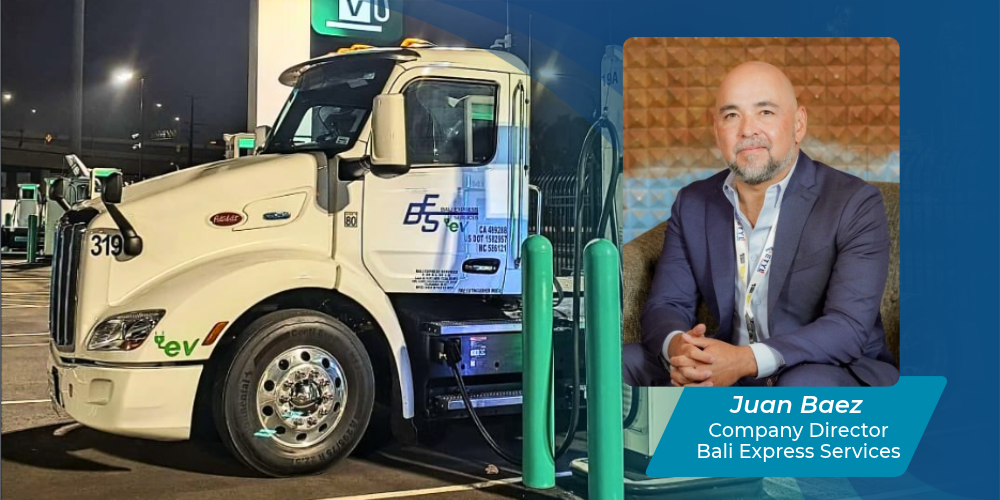
San Diego’s portside neighborhoods breathe more diesel pollution than 90% of California communities. Diesel pollution is known to cause cancer, damage lungs, and aggravate asthma and other chronic diseases. That’s why transitioning heavy-duty diesel trucks servicing the Port to zero-emission trucks has long been a priority for Portside residents. In response, the Port of San Diego adopted the Maritime Clean Air Strategy in 2021 with the goal of achieving 100% zero-emission trucks and cargo handling equipment by 2030. Critical to meeting this goal is innovative companies like Bali Express Services.
Bali Express Services is a leader in zero-emission transportation technology. It is the first transportation company to make a border crossing between the US and Mexico with an electric truck. To learn more about Bali and ZEV transportation, we spoke with Juan Baez, the company director.
This interview has been edited for length and clarity.
How did the company come about? What services does it offer?
The company emerged to meet the region’s cross-border transportation needs, providing a safe and reliable service to the maquiladora industry in Baja California that serves clients in the U.S.—primarily in California and Texas.
What motivated you to make environmental responsibility and sustainability central to Bali’s mission?
We leveraged California’s incentives to acquiring clean trucks with the goal of reducing emissions on our routes between Southern California and Northern Baja California, benefiting border communities in both countries.
Bali is the first transportation company to make a border crossing between the US and Mexico with an electric truck? That is an amazing accomplishment. How did it become a reality?
In April 2024, we became the first company to cross the border with Class 8 electric trucks. This was made possible by our management team’s vision for sustainability to reduce both emissions and operational fuel costs.
Bali is a pioneer in integrating electric units for cross-border transportation. For those of us who aren’t familiar with the logistics industry, what does that mean? And how does that reduce emissions?
To put it in context, in 2025 Bali covered 60,000 miles using clean trucks—an environmental impact equivalent to planting 2,600,000 trees. For 2026, we project a 30% increase in this impact, equivalent to 3,380,000 trees.
Part of Bali’s mission is to operate a 100% zero-emission fleet by 2035. What successes can you highlight? And what is your greatest challenge to reaching that goal?
Given the global economic environment, we have adjusted our target for a full transition to zero emissions by 2040. Our greatest achievement has been maintaining year-over-year growth in our clean fleet, regardless of state and federal regulations in the U.S.
The biggest challenge remains access to efficient, cost-competitive charging solutions across our operational footprint.
As a leader in the zero-emission truck space, what do you say to people who doubt or oppose the transition from diesel trucks and equipment to zero-emission trucks and equipment?
Adopting clean vehicles requires better operational planning. This enables greater efficiency in transit times, reduced fuel and maintenance costs, and a cleaner, more profitable operation.
Is zero-emission technology creating new job opportunities and growth for Bali?
Definitely. Using clean trucks has opened doors to new clients who are committed to sustainability and the fight against global warming. Furthermore, it positions us as a socially responsible company dedicated to environmental stewardship.
Upcoming Events
Upcoming Portside Community Action Team (CAT) Meetings
The CAT normally meets on the last Wednesday of every month. Dates and locations are subject to change. For up-to-date information and to attend, please email. You can also visit our events calendar.
- November 18, 2026, 5 PM – 7 PM