
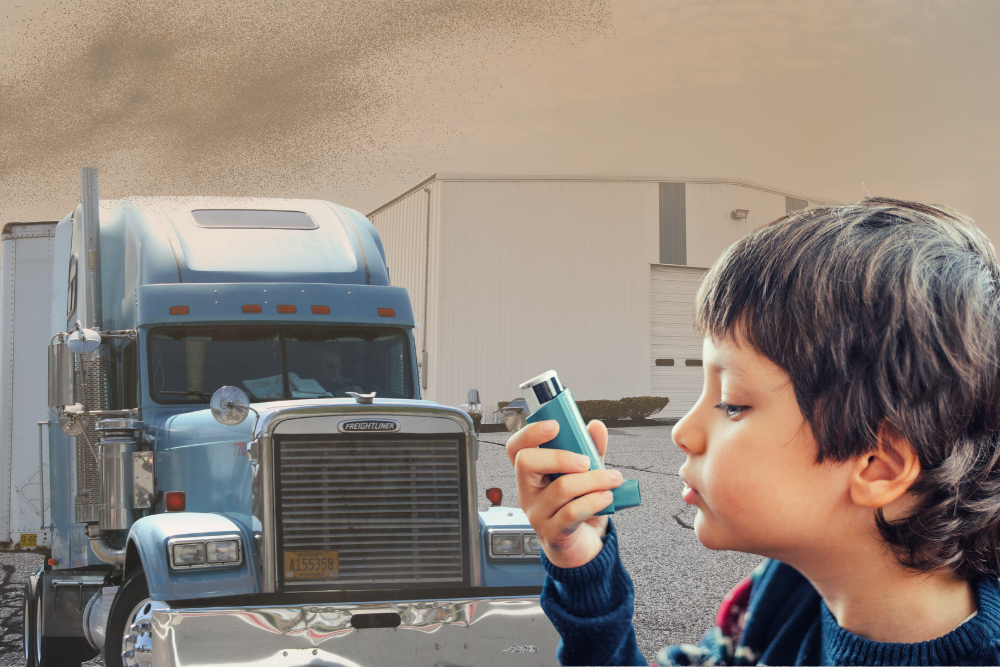
With the federal government attacking clean air, we need our local air district to step up and protect our communities.
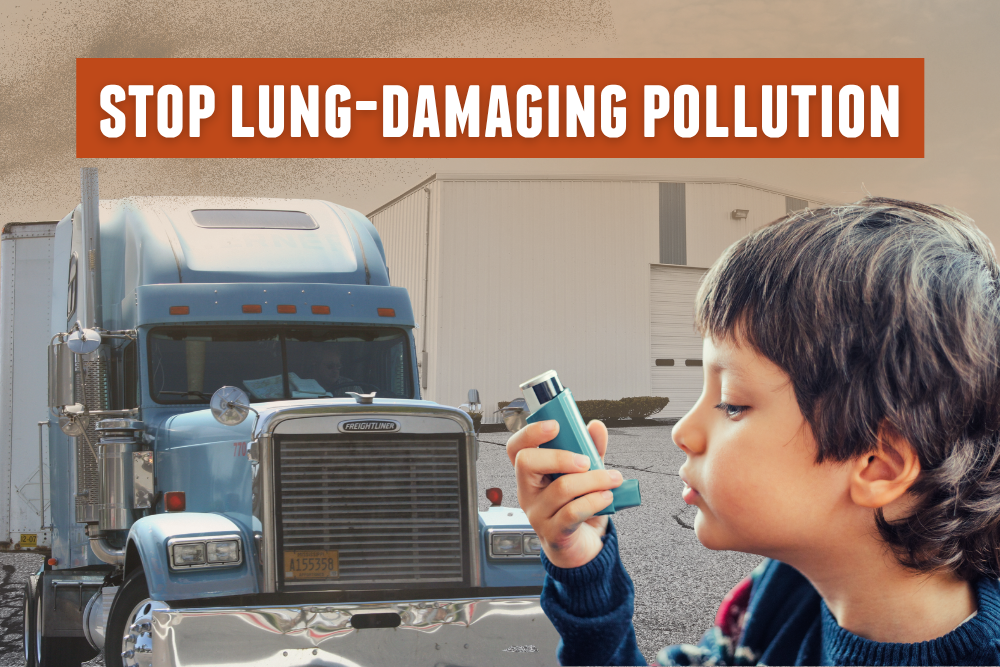
While San Diego’s Portside and Border communities already breathe some of the most lung-damaging diesel-polluted air in California, the federal government is actively waging a war on clean air protections. These communities have a higher risk of developing cancer than most of the state, and end up in the emergency room from asthma attacks at higher rates. Instead of protecting our lungs, Trump’s EPA has cancelled millions of dollars in clean air funding, is working to destroy laws that protect us from polluters, and is making it harder for California to reduce toxic emissions.
There is no rule in effect right now to stop pollution coming from highway traffic, warehouses, distribution centers, and in particular, the diesel-emitting trucks they attract. Medium and heavy-duty trucks make up only 1% of all vehicles in San Diego County, but release 13% of all diesel emissions. Last year, by issuing a congressional review, President blocked a California law that would have reduced diesel pollution by transitioning heavy-duty diesel trucks to emission-free electric vehicles.
Local action by the San Diego’s Air Pollution Control District (SDAPCD) can make a rule that requires large warehouses, that attract diesel trucks, to reduce the amount of air pollution they create. This is called an indirect source rule because that pollution would not have existed if there wasn’t a warehouse or distribution center in the first place. On April 9th, SDAPCD is going to vote on whether or not to develop a warehouse and distribution center ISR to hold polluters responsible for their emissions.

Stand Up for Clean Air
Click below to send an email today demanding SD APCD stand up to Trump and polluters by starting a warehouse indirect source rule now.
What you need to know:
- Diesel pollution is known to cause cancer, contribute to premature death, hospitalizations, and emergency room visits for worsening chronic heart and lung disease, including asthma, increased respiratory problems, and decreased lung function in children.
- Diesel emissions cause 84% of the cancer risk from air pollution in Portside neighborhoods, and 79% of the cancer risk from air pollution in Border neighborhoods
- Portside residents have a higher risk of developing cancer from air toxins than 93% of the nation.
- Barrio Logan’s rate of asthma‐related hospital visits is higher than 95% of census tracts throughout the state.
- Children in Barrio Logan and National City have more than double the rate of asthma emergency room visits than San Diego County as a whole.
- On-road mobile sources are the second-highest emitters of diesel pollution in the Portside area, with heavy-duty trucks emitting the most in this group at 43%.
- Medium and heavy-duty trucks make up only 1% of all vehicles in San Diego County but emit 13% of all diesel particulate matter.
Only the federal government has the authority to regulate mobile sources of pollution, like a delivery truck. The federal government can grant a state permission to regulate mobile sources in the form of a waiver, but the current administration has refused to give California permission. However, local air districts can regulate stationary sources, like warehouses.
An indirect source rule (ISR) is a way for local government to reduce the amount of pollution warehouses, distribution centers and other industries, generated from operations, energy generation, and the vehicles (or mobile sources) that service them -for example, a delivery truck. An ISR can require a warehouse to reduce air pollutants through multiple options, including transitioning diesel trucks to zero-emission trucks, electrifying operational equipment, and installing vehicle charging infrastructure.
- With the federal government’s aggressive assault on clean air, a local ISR is one of the last tools available to reduce diesel emissions from mobile sources in the county’s most polluted communities.
- The federal government has blocked California’s nation-leading vehicle emissions standards. This prevents the state from regulating diesel emissions from mobile sources.
- CARB rescinded its Advanced Clean Fleets rule waiver request to the EPA because the Trump EPA would have rejected it. The Advance Clean Fleet rule would require state and local government agency fleets to reduce emissions by increasing the use of Zero-Emission Vehicles (ZEVs) as vehicles are normally replaced.
- An ISR is a proven method for improving air quality, public health, and reducing air pollution. In 2024, the South Coast Air Quality Management District’s warehouse indirect source rule achieved approximately 1.47 tons per day of NOx reductions and 0.035 tons per day of DPM reductions.
- An ISR for warehouse and distribution center operations is complementary to stationary source and transportation rules by making it easier to know the total emissions and their sources, and holding them accountable for the pollution, also making it easier to measure the reduction
- The Portside and International Border Community Emission Reduction Plans (CERP) both include an ISR as a strategy to meet their goals.
- State-level actions such as AB 98 and potentially AB 1777 are no substitutes for a countywide ISR. AB 98 only applies to new or expanded warehouses, and AB 1777 only restates CARB’s authority to enact an ISR.
To Get Involved Contact

Monserrat Hernandez
(619) 952 3656